Showing posts with label Africa. Show all posts

Wednesday, 25 May 2016

Anja Ringren Loven recieves Danish medal of honour

 I remember writing about Anja and how brave she is. Well I’m not the only one who thinks so. Anja has been been given the Danish medal of her honour for her extraordinary work in Nigeria where she gives children hope and a chance at a better life.
 
       She shared the news of her achievement on Facebook and here is whay she wrote "Today I received the Danish medal of honor called "The Niels Ebbesen Medal" in the City Hall of Randers, Denmark.
The motivation for the medal: "Anja, you make a brave, selfless and
extraordinary effort to save the vulnerable children in Nigeria. Few people knowhow dangerous a mission it is - but everyone is aware of what it means for the vulnerable children who without help will end up lonely on the streets."

I will bring this medal of honor to Nigeria and give it to David ❤️ Without him I would not be where I am today. He is not only the father of my son. He is my biggest inspiration and my hero! ❤️ He is the most amazing man and this medal is undisputed because of his extraordinary efforts ❤️
Love from Anja ❤️

Congratulations Anja, you deserve this I wish I had half the gumption that you have.

Wednesday, 18 May 2016

80 young Africans from across 30 countries to write a book


 Across Africa, young achievers from the Global Shapers Community of the World Economic Forum are gearing up towards the launch of one of the Biggest Collaborations on the continent, dubbed Africa 80.

       During the 25th Annual World Economic Forum on Africa 2015 which took place in Cape Town, South Africa, 80 young Africans including 6 Ghanaians agreed to collaborate to co-author a book which will symbolize the transformative ability that collaboration amongst Africans can be achieved.
      A year on, the dream is now a reality leading to the Launch of the very first kind of a Book Collaboration among 80 young Africans from 30 countries.The book with a foreword from Ashish Thakkar , CEO of the Mara Group and Africa’s Youngest Billionaire, features Young Ghanaians who are blazing trails in diverse sectors including, Prince Akpah , Founder and MD of Avance Media and President, Africa Youth Awards, John Armah , CEO, Orios Group and Executive Director of GCEEI, Rosalin Kyere Nartey, CEO of Rosak Consult, Daniel Owusu ,Executive Director of CMG Empowerment Ghana, Kow Essuman , Lawyer, Bentsi-Enchill, Letsa and Ankomah and Emmanuel Agbeko , Founder, Urithi Labs and Director, Impact Hub Accra all from .According to the visionary, Alvin Nyika from Zimbabwe, the book will not onlycommand attention across the continent but most importantly, provoke the spirit of unity and of working together for the benefit of Africa’s current and future inhabitants.

       During the Launch of the book themed: Transformation through Collaboration,on 25th May at Sandton in Johannesburg, the Africa80 Foundation will also be outdoored to create a networking platform for co-authors to identify partners for future collaboration beyond the book launch.

Wednesday, 11 May 2016

Day 2 from Juliane Okot Bitek's 100 days

      100 days is a collection of poems that recall the horror, pain and senseless loss and innocence in the Rwandan genocide. The words are so powerful, they make you feel the emotions of living, dying, pain, loss and all other emotions that represented the madness of the genocide.

       Bitek says the poem started out by being inspired by the quiet homage to the 1994 Rwandan genocide that the Kenyan American artist Wangechi Mutu started pasting on the social media in April with the hashtags #Kwibuka20 #100Days. She says these pieces should give us a way to understand better the Rwandan genocide and other wars we have endured.


Day 2
This will not be a litany of remembrances:
We know who the guilty are
The guilty know themselves
This is a charge against the witnesses
& those who cannot speak
This is a charge against those who speak incompletely
& incoherently
Against nature who saw everything & did nothing
against the bodies that dissolved
& the ones that refused to dissolve
those that insisted on writing the landscape with bones
This is a charge against pain
against heartbreak
against laughter
against the dead.

Tuesday, 10 May 2016

For Vanity Fairs sister issue, Nigerian Author Chimammandah Adiche talks about her relationship with her sister

          I remember standing at the foot of the long stairway in our new house, too frightened to climb, everything big andunfamiliar, until my sister Uche silently took my hand and we went up together. I was 4; she was 15. It is my earliest memory of my attachment to her. But, according to family lore, the attachment started much earlier. I was a fussy baby whose nightly screaming was soothed only by her. Newly weaned, I would eat okra and liver sauce only if she fed me. “By the way,” she told me recently. “I ate all the liver—that’s why you didn’t grow tall.”

        In my teenage years she was the glamorous big sister who was studying pharmacy at university and had a handsome boyfriend in a white car. I looked up to her. Her beautiful face, seamless grape-dark skin, the gap in her teeth inherited from our mother. I was in awe of her original style. She fashioned dangling earrings from parts of an abandoned chandelier and made bows for her shoes from old handbag straps. At the back of her notebooks were delicate sketches: dresses with large sashes, lavishly shaped trousers. Sometimes she went to her tailor’s shop in the market and stood over the sewing machine to make sure the details were
right. Many of her clothes were handed down to me. At 12, I wore ruched, fitted dresses when my age-mates were still in little-girl clothes.
       I was sometimes afraid of her quick temper, her prickliness. I hated domestic work, while she always cleaned with a sweaty zeal. She often scolded me for not dusting the furniture. She was the tough one in the family—the unconventional girl. When she was in primary school, the neighbor’s son called her a devil, and she climbed over the hedge, beat him up, and climbed back home to continue her game of table tennis. That evening, the neighbors came over to report to my parents. Asked to apologize to the boy, my sister said, “But he called me a devil.” When she was at home from boarding school, she once sneaked into my mother’s wardrobe and took her high-heeled sandals back to school. They were promptly seized by a prefect. She told my mother about it more than 10 years later, describing the sandals in detail, laughing. She laughs easily and often.
       She sends funny jokes by e-mail and WhatsApp. She is the second and I amthe fifth of my parents’ close-knit six children. Because of the age gap, I came truly to know her as an adult. I fled the study of medicine to become a writer; she is a successful pharmacist. We have different tastes. She touches my natural hair and says, “What is this rough mop?” And I ask of her long, straight weave, “What’s that plastic horsehair?” Still, we ask each other’s opinions of outfits and hairstyles. We have long conversations about my book events and her pharmaceutical conferences. We talk and e-mail often. I love to spend weekends with her, her wonderful husband, Udodi, who is like a big brother to me, and her 18-year-old twin daughters.
          Now I recognize what I most admire about her: her transparency, the absence of layers, the bright, focused light that is her loyalty. There is an immense solidity to her. To be her little sister is to feel always that a firm cushion exists at my back. When our father was kidnapped for ransom, it was her steady voice that stilled my despair. “You work so hard,” she told me once, simply, matter-of-factly, during an unproductive period, and it made everything seem better. She turned 50 in early March. “Don’t get me cards that say,‘Happy 50th birthday,’ ” she told my siblings and me. “Just ‘Happy birthday’ is fine.”

Thursday, 17 March 2016

Africa can read

       Yes! Africans can read, meetPhilani Dladla, a homeless man living on the streetsof Johannesburg, isprobably the last person you’d expect to be a bookworm. Yet, the 24-year-old is quite a voracious reader. And instead of begging like other homelesspeople, he has chosen to make a living by reviewing and selling books.
South African director and cinematographer Tebogo Malope played a
tremendous part in bringing Philani’s unique and inspiring story to the
world. Malope, 29, recorded an interview with Philani called the ‘Pavement
Bookworm’; the videos have gone viral since he put them up online last
year.

        The two-part interview features Philani speaking about the books he has
read and why he likes them – the man is so full of infectious joy as he
discusses his love of reading. His sense of passion and appreciation of
books is extremely rare, especially for someone who leads a difficult life.
Philani seems unfazed by his own living conditions, he only wants to tell
the world how great it is to read.

       On a typical day, Philani stops at various streets in Johannesburg with a
pile of books; on request, he will review the books, the authors and even
the publishers. “He has read all the books in his collection and is always
seeking for more to read,” said Tebogo. “He then sells some of his books
as a way to raise money for himself and some of his homeless friends.”
It is seriously amazing to watch him talk about books. His favorite author,
he said, is John Grisham, because he “touches on social justice and I think
that’s the one thing lacking in the world.” What I found most amusing was
his review of the Jodi Picoult novel, My Sister’s Keeper.

          “You know, when you got a car. But this car, it always gives you problems.
Now, you go maybe buy a second-hand car just to take some parts from
that and fix this one. This lady, she was suffering from leukemia. So her
parents decided to give birth to another sister, so she’s gonna be like a
donor,” he explained wisely.

         Philani began to appreciate books when he managed to rescue himself
from drug addiction by reading self-help books. “I hate drugs, because I
know what drugs can do to you,” he said. “And drugs can turn you into a
money-making machine. You can work four hours, you get four hundred,
and go spend that four hundred in four minutes. So, four hours, four
hundred, four minutes, all gone. Just imagine, all that effort.”

          He points out that reading, on the other hand, can never hurt you. “I
promise, reading is not harmful,” he said. “There’s no thing as harmful
knowledge, this thing is only going to make you a better person. Reading is
good for kids, for adults, for grannies, for people in old age homes. You can
go to old age homes and see how many people read. That shows that you
can never get enough of knowledge, because these people they are old, but
they still read every day.”

         Philani is especially concerned that kids these days do not read enough.
For kids, he says, he doesn’t mind giving his books away for free. “You
come here, you see kids, they are busy with their BBMs. All they care about
is blah, blah, blah, blah, blah. But you’re not acquiring any new knowledge,
you’re not gaining anything. It’s just to kill time.”

          According to Tebogo, Philani is a “great role model on the power of reading
and can be an amazing ambassador for our young people.” The director
also said that he’s appealing to anyone that can somehow contribute to
Philani’s life.

      Thanks to the video interview, motorists are actually stopping when they
spot the pavement bookworm – to chat with him and probably even pick
up a book or two. His finest moment was when he had a visit from Steven
Boykey Sidley, the author of Entanglement and received a copy of his
latest book.

Friday, 11 March 2016

Zeraffe? Gebra?


         The answer is neither,  Meet the Okapi a mix between the Zebra and the Giraffe I guess its safe to call it a Gebra.
The Okapi  was first discovered in 1901. Although scientists say it is closely related
to the giraffe, it looks like the result of a love story between a giraffe and a
zebra. The Okapi can only be found in the Ituri forests, north-east of
Congo, in Africa.

Wednesday, 9 March 2016

Meet Buthelezi the artist who sees beauty in waste

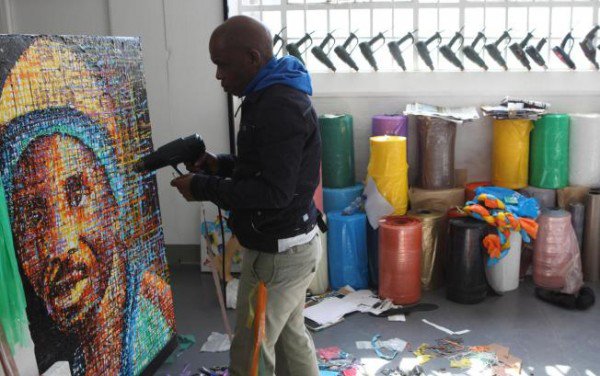
For most of us, our normal reaction to waste of any sort is to hold our breath and walk by as fast as we possibly can well most of us except Mbongeni Buthelezi.

        Meet Mbongeni Buthelezi, an artist from South Africa, has shunned paint in favor
of plastic. He melts discarded plastic bags and uses the molten material to
produce stunning works of art. The 49-year-old has been working with the
unique medium for the past 23 years, ever since he graduated from art
school.

        Buthelezi said he decided to work with plastic because he wanted to stand
out, and this was an innovative, original idea to do that. “With watercolor
and other mediums that I have experimented with in the past, I felt that
I’m hitting the ceiling,” he told Euronews . “I’m not growing anymore. I
wanted to be noticed and I wanted to catch attention, because I knew also
that I’m moving into a career where you have to be really special to be
able to even make a living out of it.”

      According to Buthelezi, his chosen medium also serves as a metaphor for
life. “I collect rubbish and create something beautiful from it,” he wrote on
his website. “That’s what we can do with ourselves and our lives.”

      Buthelezi’s introduction to plastic happened during a workshop he attended
with a Swiss artist who used plastic as a canvas. Inspired by the idea, he
started to think of how cheap and readily available plastic is, and how it
could be used not only as a canvas, but also as paint. So he collected
plastic and started experimenting with a heat gun, applying the melted
material onto a black plastic background. He slowly worked on improving
his technique, and eventually became an expert at painting with plastics.
He calls his creation process simple and haphazard, but believes that the
final pieces speak for themselves. “I’m interested in finding the details in
the painting, but also, as you step away from the piece it really comes
together,” he told BBC news.

        He also called himself “a mirror for the
society I live in, and I want to make a meaningful impact on that society.”
In his paintings, Buthelezi depicts a variety of subjects – everyday scenes,
African history, human portraits, and abstract images. He also makes bold
statements about social and environmental issues. In one painting, he’s
used purple and orange soft drink labels to paint the clothes worn by
women chatting on a street corner. He wants the rough texture of the
plastic to represent the difficulties of life in South Africa’s townships. He
also has a series of black-and-white portraits of children playing – which
is important to him because his own childhood was more about hard work
and independence.

      According to Buthelezi, he is the only artist who works with plastic. He
likes that, because an external point of reference could mess with his
originality. But he also says that melted plastic is an easy medium to work
with, especially for those who may not be able to afford traditional art
supplies. “Anyone can gather plastic waste and start painting, and
construct something out of nothing,” he said.

         Buthelezi’s works have been well received by critics and art lovers alike. In
2010, online magazine Live Out Loud said his art “reflects humanity’s
often detrimental impact on the environment, but his original use of
discarded objects to depict an often forgotten group of people truly sets
him apart.” His paintings have been exhibited in South Africa, as well as
Germany, the US, and Holland, for years. To check out more of his work,
you can visit his website: http://www.mbongeni-buthelezi.com/

Monday, 18 January 2016

Mrs Somebody

          “Fessura” is the Italian word for flaw,I could think of a thousand flaws
that plague the human existence like cancer for example or a destructive
influx like the Ebola virus that had the most part of the African continent
worried for a minute. Everyone,knows what flaws are and no one wants to be
identified with one. I for example happen to suffer from an extreme case of
malignant inertia,I just cant seem to ever get things done on time. Well, at
least I admit to mine.

         One flaw we never want admit if we even consider it a defeito
(portuguese for flaw) is the pressure we put on the girl to have a little gold
band on her finger. If,that isn’t a fehler(German for flaw) then you my friend
are as anachronistic as they come. Irrespective of your dreams,who you are
and who you want to be. It is assumed that the woman is not a complete
being simply because she lacks the little gold band on her finger. We may
think that the trend of wearing tight laced up corsets went with the Victorian
era, what we do not know is that the average African girl is still very much
enslaved by the corsets of finding a good husband that society has her so
tightly laced up in.

         The girl must marry or she is considered persona non grata and so to
snag herself “a good catch” she has to go through the arduous task of going
to the virtual market with other girls of her kind where she is expected to
compete with them to sell her self by using the best feminine tricks and
charms so that she gets the best buyer(a good husband) the man is the
demand and she is the supply. And if she doesn’t succeed at selling herself
right and gets no buyer she becomes a thing of mild popular contempt and in
extreme cases labelled a failure.

          There is more to being a woman than the little gold band,a woman’s
happiness,wealth,social distinction,reputation,ease and self actualization
should not always come to her by being “Mrs somebody”. What if? I didn’t
want to be a female gypsy moth who lives a dependent life,whose whole
essence of living is centered around the male moth who lives a dependent
life, whose essence of living is centered around the male moth, who seldom
moves more than a few feet from the male pupa,who has aborted wings and
so cannot fly, who waits patiently and obsequiously subserviently for the
winged male lays her eggs and then dies. What if I wanted my life as a
woman to count for something without being “Mrs somebody”.

Saturday, 16 January 2016

Lassa fever; All you need to know about the virus

What is Lassa Fever?
         Lassa Fever is a severe and often hemorrhagic illness caused by the lassa virus. Since its original discovery in 1969 in the village of Lassa in Borno State, Nigeria. Lassa virus is a member of the Arenaviridae virus family. Humans contact the virus primarily through contact with the contaminated excreta of the Mastomys natelensis rodents(multiple breasted rats)
            The rodents live in houses with humans and deposit excreta on floors, tables, beds and in food. Consequently the virus is transmitted to humans through cuts and scratches or inhaled dust particles in the air In some regions, Mastomys(the rats) are consumed as food.

Symptoms of Lassa Fever
       Death from Lassa Fever occurs 10-14 days after symptom onset. Its symptoms are

fever
sore throat
diarrhea
pink eye(conjunctivitis)
back pain
swelling of the face
protein in the urine
mucosal bleeding(nose, mouth, lungs and digestive tract)
cough
stomach pain
vomiting
loss of hearing
tremors
encephalitis(inflammation of the brain)

Treatment and cure
        Like Ebola and any other diseases bedevilling the world today, there is no cure. However ribavirin an antiviral has been used with success in people affected by the virus. It has shown to be most effective when it is administered early in the course of the illness.

Friday, 15 January 2016

What you need to know about personalized medicine

What is personalized medicine

           Personalized medicine is a young but rapidly advancing field of healthcare that
is informed by each person's unique clinical, genetic, genomic, and
environmental information. Because these factors are different for every person,
the nature of diseases—including their onset, their course, and how they might
respond to drugs or other interventions—is as individual as the people who
have them.

           Personalized medicine is about making the treatment as individualized as the
disease. It involves identifying genetic, genomic, and clinical information that
allows accurate predictions to be made about a person's susceptibility of
developing disease, the course of disease, and its response to treatment.
In order for personalized medicine to be used effectively by healthcare providers
and their patients, these findings must be translated into precise diagnostic
tests and targeted therapies. This has begun to happen in certain areas, such
as testing patients genetically to determine their likelihood of having a serious
adverse reaction to various cancer drugs.

           Because the 2003 sequencing of the human genome provided crucial insight
into the biological workings behind countless medical conditions, scientists and
physicians are advancing the field of personalized medicine at a fast pace. It is
not yet an established part of clinical practice, but a number of top-tier medical
institutions now have personalized medicine programs, and many are actively
conducting both basic research and clinical studies in genomic medicine.
Specific advantages that personalized medicine may offer patients and clinicians
include:
Ability to make more informed medical decisions
Higher probability of desired outcomes thanks to better-targeted therapies
Reduced probability of negative side effects
Focus on prevention and prediction of disease rather than reaction to it
Earlier disease intervention than has been possible in the past
Reduced healthcare costs
Personalized medicine is not to be confused with "genetic medicine." Genetics, a
field more than 50 years old, is the study of heredity. It examines individual
genes and their effects as they relate to biology and medicine. "Single cell"
genetic diseases include muscular dystrophy, cystic fibrosis, and sickle cell
anemia. (However, even these seemingly "simple" hereditary disorders can be
influenced by other genes, as well as by environmental factors such as diet and
exposure to toxins.)

       Genomic and personalized medicine aims to tackle more complex diseases,
such as cancer, heart disease, and diabetes, for years believed to be influenced
primarily by environmental factors and their interaction with the human genome.
It is now understood that because these diseases have strong multigene
components—and in some cases might be caused by errors in the DNA between
genes instead of within genes—they can be better understood using a whole-
genome approach.

Should personalized medicine only be used for sick people?

        Definitely not. Because an individual's genome influences his or her likelihood of
developing (or not developing) a broad range of medical conditions,
personalized medicine focuses strongly on wellness disease prevention.
For example, if a person's genomic information indicates a higher-than-average
risk of developing diabetes or a particular form of cancer, that person may
choose a lifestyle, or sometimes be prescribed medications, to better regulate
the aspects of health and wellness over which he or she has control. The
person may benefit in the long run from making preventive lifestyle choices that
will help counteract the biological risk.
Genomic medicine may help determine a person's risk of developing several
specific medical conditions, including:
Cancer
Cardiovascular disease
Neurodegenerative diseases
Diabetes
Obesity
Neuropsychiatric disorders
Researchers are actively investigating the genomic and genetic mechanisms
behind—and developing predictive testing for—such diverse medical conditions
as:
Infectious diseases, from HIV/AIDS to the common cold
Ovarian cancer
Cardiovascular disease
Diabetes
Metabolic abnormalities
Neuropsychiatric conditions, such as epilepsy
Adverse drug reactions
Environmental exposure to toxins

Cullage: health.usnews.com

Wednesday, 9 December 2015

Ukeme's Story

           His name is Ukeme and we all thought that he was senile well until today. When I arrived here the first thing i noticed was how many mad people they had here and just how dehumanizing the symptoms of their illnesses were. Ukeme however was different from the lot he was always extra quiet, when he stared at you it was like he could see right through your soul and just like Solomon Northrop from 12 years a slave he's eye's always held so much pain. We all stayed clear of Ukeme except for Edith who would say "my fine friend" whenever she saw him and then in those rare moments Ukeme would smile and a dashing smile it would be.
          
           Over time, that "quiet  mad  man" as I used to call him started to look.sane he started to look better and healthier. Did I mention that in the state of he's senility he looked disturbingly anorexic so putting on a few pounds was a really really good thing. Well until I saw him again two weeks ago reeking of rotten flesh with his left hand hidden in his shirt away from public glare and my first thought was oh no! this man is back to being mad again he probably slept at a dump site or something. Until last Sunday when I saw him walk by and I saw his hands the one he tried to hide.

           They were black, gangrenous, mangled and dead! the whole left hand had been eaten by gangrene it was the most disturbing thing I had ever seen, the more I thought of it the more I knew that something was amiss and so, I became obsessed with knowing this man's story. Today I did, Ukeme was never mad but he's father is. For the past 16 year's of he's life  he's suffered untold abuse physical, psychological and mental in the hands of the very man who brought him to this world.

           Last year, he was taken to a herbalist's den by his father to be cured of his so called madness as well as witchcraft. There, he suffered mutilations, starvation and beatings until he managed to escape but after that he was never  the same again. That experience , took away his believe in humanity and so he chose to become mute, last month he had malaria and since be heard that malaria can be cured by moringa he took some of the leaves from his father's compound and because he's son used his precious moringa, he's abusive father did what any possessed lunatic would do. He had thugs beat up his son with chains and pestles and put his left hand in raw acid for hours!

          Ukeme will never use his left hand again, he will never do a lot of things. I leave this place come Friday and Ukeme's story has taught me that sometimes the mad man is not mad it is the people that call him mad that are mad.

Tuesday, 24 November 2015

How do you get a husband?

     They tell you to get a husband, they tell you to find a husband, they tell you to bring a man home. What they don't tell you is where to or how to find a husband. Do you find a husband in the market when you go to buy atarodo?  or, do you find a husband when you go to church may be that's why there are so many single women in the choir and ushering unit, do you find a husband when you go to weddings may be perhaps that's why asoebi girls are so popular, or do you find a husband when you go to the mall? may be thats why Spar and Shoprite are so popular.My friend J likes to stroll every evening she says she is looking for a husband, she says you wont find a husband if you just sit at home, she says men are scarce.
          Why must i look for a husband? i asked my mum once she looked at me like i had grown two horns on my head.

please how do you find a husband?